I received my PPL after 55 hours of training. This is the story of my 56th hour: my first as a private pilot.
VFR pilots aren't allowed to fly through clouds, but clouds were all that I could see between myself and my home airport. I was headed west, following the ridge line of the Santa Ynez mountains, looking south towards Santa Barbara and the ocean. Not that I could see either of them.
A marine layer (low-level fog found in coastal areas) is very common in Santa Barbara. The clouds form as the temperature cools and gradually creep in from the ocean, swallowing the coast, the freeway and the foothills before getting cut off by the mountains. I was on the other side, above the layer and several miles to the north of it. The Santa Ynez valley was clear as could be, but I wasn't sure how I was going to get home.
I thought about picking up some altitude and flying over the clouds to see if there were any decently sized holes that I could drop through, but a quick check of SBA's automated terminal information service disabused me of that notion. The ceiling was 1,200 ft. 1,200 feet doesn't leave much room beneath the clouds and above the buildings, hills and towers of our town. Besides, the weather had been pretty decent when I left SBA and that wasn't too long ago. The 1,200 foot report was 15 minutes old and it would be another 10 to 15 before I could get there. As the temperature dropped, things would get worse instead of better.
Situations like this one are why "Aeronautical Decision Making" is a category that would-be pilots must get through during their written and oral exams. In a car, you can pull over and wait out the weather, ask for directions, or do whatever you have to do. In a plane, you always have to have a backup plan for getting down safely.
My backup for this trip was Santa Ynez airport (IZA). IZA is only about 18 nautical miles from SBA, but it's on the other side of the ridge and significantly protected from the encroaching marine layer. I handed iPad to my wife and talked her through my in-flight navigation app. I needed the radio frequencies and runway elevation information that I'd need to land at IZA. I informed the Santa Barbara departure controller that I wanted to cancel flight following and switch frequencies. Melch read off the numbers I needed and I hopped on the radio to get the weather and announce my intentions to other aircraft. The wind was 220, so I'd be using runway 26. The runway was already visible directly ahead of me and a few thousand feet below.
IZA is an un-towered airport, so aircraft are expected to announce their intentions over a common radio frequency that all planes in the area monitor. Instead of getting instructions from a controller, pilots are expected to fly in a prescribed pattern at a prescribed altitude. The radio and the pattern combine to make the environment safer for everybody. I was way above the pattern altitude, and pattern entry is 45 degrees from the downwind side. I needed to descend, pass the airport, turn around, and re-enter the proper way. I got on the radio and announced that I would do exactly that.
The pattern and landing were pretty smooth and I taxied off of the active runway and took the first available parking spot. I needed to get some more information on the weather in order to plan my next move and I needed to use the bathroom.
So how did my first 0.7 hours as a private pilot end with me taking a leak in the men's room on the wrong side of a mountain?
The plan was to take my wife up for her first trip with me. For a destination, we selected Santa Monica (SMO), where we would stop at the on-airport restaurant for a bite and then return at sunset in order to catch the view over Malibu and the Channel Islands. We hoped to lift off around 2:30-3:00pm in order to get out there and back before it got completely dark (I am allowed to fly in the dark, but the view isn't as good).
Planning for such a flight begins the night before. Obsessive checking of the weather can start 24-36 hours out depending on how far ahead the airports offer Terminal Area Forecasts. Taking it easy on the drinking and partying don't hurt either, even for an afternoon departure. The forecast called for early morning fog gradually burning off into clear skies in the afternoon. Apparently I had picked the perfect time to fly.
Late that morning I went to the gym. It was a bit cloudy on the way over, but things looked better on the way back. Santa Monica had been reporting solid fog in the morning, but was only reporting haze by 1:00pm. Santa Barbara reported few clouds and good visibility. We headed to the airport.
By the time we got there, Santa Monica was STILL reporting marginal visibility. We decided to ditch the trip over there since half of the fun would be the view of Malibu and the LA beaches. No fun if you can barely see them. Besides, this was my first time flying with non-instructor passengers so I wanted the best weather possible. Accidents happen when you try to push too many envelopes at once. For example, I'd be totally willing to fly at night, over mountains, in a plane I'd not flown before or to a place I'd never flown before. I just wouldn't do any more than one of those things in a single flight!
With Santa Monica out of the picture, we tossed about the idea of going up to Pismo. Pismo doesn't report weather, but Lompoc and Santa Maria are somewhat nearby and they were both reporting clear skies. Even so, I knew that Pismo was closer to the coast and therefore more likely to be foggy. We had a pilot report suggesting that Gaviota was foggy and Gaviota was a third of the way to Pismo.
I contacted a flight briefer and got an updated weather report. Gaviota and Vandenberg were indeed fogged in, so the coastal route was out. The inland route was clear though. Santa Barbara was forecast to remain clear skies for the next 9 hours, with a few scattered clouds off the west end of the airport. More than enough time for us to get out and back. I contacted clearance delivery and requested an inland route.
Once I got airborne, the tower sent me off to the west (the coastal route) anyway. I obliged for a bit but told them that I didn't want to get too far that way since it would mean flying into clouds. Once I got above the approach path for runway 7, the controller let me have my way and vectored me off to the north and away from the clouds. I happily climbed out, aiming to get over the mountains near the 154 pass and on my way.
The plane isn't the most powerful in the world, so it took me some time and distance to get high enough to clear the pass. We made it though and I crossed over and headed for Lake Cachuma. The clouds had been closer to SBA on climb out than I had expected and I was concerned about taking too long before heading back. After flying along for a bit I turned back towards the ridge to get a look back at SBA. I hadn't even been up for 30 minutes yet, but you already know what I saw.
In the end, everything worked out. We landed at Santa Ynez and I was able to talk with some airport personnel and another couple who had just landed there for the same reason we had. It turned out that they lived down street from us in SB and had been attempting to return home after a weekend in Tahoe. The forecast had led them to believe that they would be able to get into SBA with no issues, but they had found it completely covered up by the time they made it over the ridge. We shared a rental car back to SB and called it an evening.
Lessons? The good was that I made the right call in not turning back once it became clear that the clouds were coming in fast. I handled the situation well, executed a textbook diversion and ended up safe and sound on the ground. The bad was that my very first flight as a "real" pilot required a diversion so quickly. Looking back, the second that I noticed that the clouds out to the west were far closer to the field than reported, I had time to turn back and call it a day. Once I made the decision to climb out over the ridge, I committed myself to trusting a weather report that I already had evidence against. The ugly was probably that I was a little slow in contacting the tower in asking for vectors to the north. I stayed clear of the clouds as required, but I could have been more proactive in communicating the situation and my intentions.
At the end of the day, we were safe and back home in SB. The only real downside was that I was on the hook for a plane that was at the wrong airport. What did I do about that? The answer is hour 57, which is an adventure for another day.
Tuesday, November 27, 2012

Monday, November 26, 2012
The Power Of Flight
TLDR: I'm a pilot now. Read on if you want the rest of the story on this 8 month adventure.
 |
| Me and my trusty steed |
So there I was, sitting in the tiny cockpit of a Cessna 152, literally hip-to-hip with the FAA inspector. I'd just cut the engine after demonstrating the two remaining maneuvers on my private pilot check ride. I hadn't nailed my airspeed on the go-around, but the procedure was right and I was pretty sure that the gap was within the test standards. The short-field landing wasn't exactly at the point I'd intended, but I thought I was well within the 200 feet allowed and I definitely landed on center line I was pretty sure that the landing speed was right on, but not very sure...
The inspector didn't seem happy.
He mentioned that I had taken a while to straighten out on final approach. He had comments on a few of my radio calls, but noted that it wasn't that I was wrong, just that he would have done things differently. He wound up his head set and opened the door.
"Well, I need to go in and do the paperwork." I knew he had to do paperwork. Wanted to know: the GOOD paperwork, or the BAD paperwork!?!?
Stepping out and without even a hint of a smile, he continued, "congratulations."
He walked away, leaving me to push the plane back, pack up my gear and vow to never push my chips in against this guy in a poker game.
It had been an adventure. I got my pilot's license almost exactly 8 months after my first flight. I had 55 hours of total time logged, 15 more than the required 40, but 5 fewer than the national average of 60. I'd wanted to do it faster and in fewer hours. It would have been cheaper that way, and there had been opportunities for cool trips this fall that I could have taken had if I had earned my license by then. I also don't prefer to excuse half-assed efforts from myself.
Half-assed might be overstatement, but I had been less than 100% focused. Working for a startup is always a bit of a demanding enterprise, and I have contract work obligations above and beyond my normal day job. I have a rugby team commitment as well, which means practices, gym time, games and team functions. I have a frisbee habit to deal with. The Guinness at Dargan's Irish Pub doesn't drink itself and RG3 won't cheer for himself. Basically, if I had committed to "dropping everything," there would have been more than enough "things" to drop. But I didn't drop everything, so I'd have to put up with a less-than-optimal pace.
Beyond that, there were elements beyond my control.
I fly out of a busy airport with commercial jet traffic and many radio frequencies. That's actually great experience, but it means that it takes longer to get from the ramp to the runway, longer to get cleared to take off, longer to get from the airport to an area suitable for practicing maneuvers, and a more crowded pattern. A more crowded pattern means fewer practice landings per hour.
My plane went in for a major engine overhaul once, forcing me to compete with other students for time in another type of plane. That meant extra time learning the new machine and less availability for lessons. Although my first solo was in the same 152 that I used for the check ride, I later completed the requirements to be endorsed for solo flight in a 172 as well. This is also good experience, but it added to the time and cost of my training.
The 152 came back from the engine work for a while, then went back in for an avionics refresh that took the better part of a month. I continued with my cross country training (in the 172), but had to wait for the 152 to come back before I could prepare for the check ride.
Once they plane DID come, back, I scheduled a check ride. My first at the check ride started a few hours behind schedule due to a delay with the paperwork of the student being examined before me. That meant less daylight for me to do my portion of the flight. I completed the cross country, ground reference maneuvers, emergency maneuvers and stalls required, but had to discontinue the test due to failing light before I could demonstrate the performance take offs and landings.
My second attempt at the check ride was on a day that started calm but ended up with a stiff cross wind. I made it through most of the maneuvers but left without passing the short-field or go-around.
After the second attempt, all I had left was 15 minutes. Two trips around the pattern and one landing. I went up with my instructor for a last practice session before the plane went in for 100 hour maintenance. The plane was scheduled to come back on Monday morning and the final section of the check ride was scheduled for Tuesday morning.
By Monday night, the plane still wasn't back, so we canceled the Tuesday appointment. Wednesday came and went so that took us into Thanksgiving. I figured we'd have to wait until after the holiday weekend and reschedule. My first attempt at the check ride was on November 4th. I joked with my instructor about whether I would finally wrap it up within the same month or even the same year.
Then I received an unexpected call from my instructor at 5pm on Friday evening. The plane was back, he said, and the inspector was available on Saturday at 1:00pm if I was free. I wasn't free, I'd told some friends that I'd join them for some frisbee on the beach. Now I'm the kind of guy that really likes to play frisbee on the beach, but I wanted to get the check ride in while I had the opportunity. I told my instructor I was free and asked if I could stop by an hour early for a few practice laps and to get things ready to go before the inspector arrived.
I slept in and spent the morning going over the Pilot Test Standards for the teeny, tiny, eensy, weensy portion of my check ride that remained. I triple-checked my head phone batteries, made sure that I had the weight-and-balance right and I didn't bust for taking off over gross weight, and generally tried to make sure that there was no chance in hell that I would need a fourth run at this thing.
At 11:00, the inspector called and said that he'd wrapped up at Oxnard and was heading over to Santa Barbara presently. He'd be there at 11:00, an hour and a half earlier than I'd expected. He said that if I wasn't ready he'd be happy to head to a nearby restaurant or something and wait for me to show up. I hadn't even cooked my breakfast yet! I liked the idea of having things ready to go when he got there much more than the idea of him twiddling his thumbs over pilot bar brunch thinking up creative ways to pink slip me.
Maybe I was a bit eager or impatient, but what do you expect? We call this space "Mr. Pinto's Adventures," not "Mr. Pinto takes it easy, has a pleasant and un-rushed breakfast and then embarks upon an errand in due course." I told the inspector that I was on my way, put an energy bar in my flight bag, checked my headset batteries and paperwork for the umpteenth time and got in the car.
The earlier start meant a bit of a rushed feeling and no practice laps, but the reality was that I wasn't getting any more ready. I'd re-read the PTS enough, I'd had enough fun with the head set batteries. I woke up that morning with 166 landings to my name and all I had to do was make 167 as good as 166.
I got to the airport and was halfway through pre-flight when the inspector arrived. I gave him the paperwork materials he needed, finished the pre-flight and it was time to go. It's one thing to be impatient or to rush through breakfast, it's another when flying: I slowly and carefully went through all of my check lists and procedures.
The wind had been calm when I arrived at the airport, but it was both shifting and increasing as we did our pre-flight run-up. It was still well below what I'd dealt with the last time, but I resolved to monitor the situation on my first time around the pattern. The sky was brilliantly clear.
The first time around the pattern I set up to land. I wasn't going to land though - at some point the inspector was supposed to call for the go around. He didn't rush in that obligation. felt like I was almost over the numbers by the time he told me to climb out. The maneuver went fine and the cross wind wasn't terrible, but it was definitely there. I had a decision to make.
You always want to land into the wind, but doubly so when you've got a short field. The head wind lowers the plane's ground speed, which means that your brakes have less work to do once you land. A cross wind doesn't give you that assistance. Even worse, you have the distraction of managing the cross wind itself. Failure to do so could lead to landing off of center line, an automatic and immediate failure on a check ride. Of course I've been trained to manage a cross wind, but it does add to the degree of difficulty.
So the decision was: do I take my assigned runway (runway 15) and accept the cross wind? Or do I request the big perpendicular runway (runway 25, the one that the big jets use)?
I have "home field advantage" on 15. Of my 166 landings at the time, probably 150 of them were on runway 15. I know all the little landmarks that for when to turn. It's very easy for me to tell if I'm coming in high or low. If the tower sends me off into the hills in order to make room for other landing traffic, I'd more easily be able to get my approach back on track.
15 is also a smaller runway, which in this case is an advantage. Landing a tiny plane on a big runway actually leads to optical illusion - the runway is larger than you're used to, so your brain thinks it's closer and lower than it actually is. As a pilot who frequently lands on smaller fields, you have to be aware of that illusion when attempting a precision maneuver on a big runway. Of course there's no real-world reason why you WOULD need to attempt a precision maneuver on a big runway - big runways are flat, hard, long and wide. Landing a tiny plane on one is incredibly easy. This wasn't the real world though, this was a contrived test example, so I had additional requirements. The runway might have been big in my eyes, but not in the test standards. If I didn't land on the centerline, within 200 feet of a designated spot and at a very low speed, I'd fail - even if the landing was perfectly smooth and safe.
There were other disadvantages to 25 as well. I knew there was a plane on short final for that runway already and a jet had been vectored in from a ways out. I would have to either squeeze in between the two of them or get delayed by the tower in order to space me behind the jet. If that happened they might send me on an "extended downwind" away from the airport environment where I wouldn't have the usual visual cues for starting my descent. Big jets might like straight-in approaches, but I'm not used to them so I'd have to focus on my altitude. Not a huge problem, but it would raise the level of difficulty.
Those are the cons, but there was one huge pro: the inspector had criticized me the last time out for using 15 even though I had to fight a cross wind. Another pro: I'd practiced on 25 the week before, just in case this situation arose.
The spacing situation with other traffic was an issue, but if I didn't like the approach I could always go around and try again. I'd only fail if I actually landed the plane outside of standards. Besides, extended down winds or 360s for spacing happen all the time at my airport, so I'm probably more accustomed to landing in those situations than most pilots at my extremely low level of experience.
By the time I was over the ocean, I knew that I was going to take 25. I was confident that I could hit the landing on either runway. Really, it's a silly decision to play up: pilots have to be able to land planes. In cross winds, on short fields, on big runways, with the engine dead or on fire, in a house, with a mouse, etc. We train for all of those things. The thing is though - the check ride isn't just about the maneuvers and the landings. The inspector is also instructed to judge students on their decision making. I'd already been criticized for taking a cross wind when I had a head wind available. I might make a new mistake, but I wasn't about to make the same mistake twice! Even though the wind was lighter than it had been the last time around, I had no hesitation in asking for 25.
The controller cleared me for 25, behind the plane on short final and in front of the jet. As expected, I was asked to make a short approach. That's the opposite of what I wanted - you want a wider pattern and longer approach for a short-field landing because you have more time to get your airspeed dialed in. I weighed the go around option but opted to give the approach a shot. The inspector allowed me to pick a target point that was a little ways down the runway. That gave me a more normal approach in terms of length, but I'd have to ignore the normal targets that I use for landings - the numbers on the runway and the slope indicator (when present, as it is on 25).
The short-field approach speed for a C152 is 54 knots. For the past quarter mile I probably never went below 54 or above 56. Dialed in. I crossed the numbers to the left of center line. I flicked the right wing down and nudged the rudder to line up, rounded out, flared and dropped it right where I wanted it.
That's pretty much exactly the same thing the time I did when I failed on 15 with the cross wind. The last second center line adjustment meant I had my eyes out of the plane and didn't know what my touch down speed was. I knew my approach speed was dead on, but my first failure was for touch down speed, not approach speed. Touch down should be way lower as you "flare" the nose of the plane up which should slow you down. I'd done that, but I don't know HOW slow I'd gotten it. The inspector offered no assistance on the matter. Other than mentioning the center line, the didn't say anything one way or the other.
I got on the radio with ground, worked out the taxi instructions back to my parking area, taxied over and shut down.
So there I was, sitting in the tiny cockpit of a Cessna 152, literally hip-to-hip with the FAA inspector....
As adventures go, getting my PPL is right up there on my lifetime list. Humans dreamt of powered flight for a long long time before we eventually figured it out. I'm extremely fortunate to be alive in a time and place where it's a possibility for a normal bloke like myself.
It was time to celebrate.
 |
| Tastes like victory |
 |
| High fives all around! |
Sunday, November 18, 2012
Huntington Beach Rugby Tournament
On November 10th, I was supposed to be running a leg of the SB Marathon relay with my company, but the Grunions also had a tournament in Huntington Beach, so I was double-booked. RightScale had luckily just hired a runner though, so I ditched my relay spot with him and headed south for some rugby.
 |
| My trusty companions for this adventure |
 |
| A rare sight: Pinto with ball-in-hand |
After the game we traveled to Balboa Island to visit the Carbones, some old friends from Softshare. For the second weekend in a row, I had to make the drive back north on Saturday night in order to rest up for flight testing. For the second week in a row, that'll be a story for another day. =)
Saturday, November 17, 2012
The San Diego Color Run
So the "Color Run" is a 5K, where you get sprayed with a different color every... K. That's pretty much the entirety of the gimmick, but it's a good gimmick. Good enough that hordes of Southern Californians turned up for the San Diego running of the event.
I was there with Melch, Oura, and a team of small but feisty asian friends of Oura's.
 |
| Feistiness, I guess |
The color is dispensed in a kind of dusty non-toxic powder that gets everywhere. Adding to the fun, runners are allotted a few packets of the stuff for their own use - to douse one another prior to the run, for photos afterward, or for whatever other purpose they might desire. We used ours for a photo:
 |
| Color everywhere |
The race itself wasn't much of an event. Half of our team was walking and the other half was jogging, but at a slower pace than my usual race pace. That left me with more time for shenanigans, white-boy dancing, and a mid-race bathroom break so I was suited just fine. The tutus weren't my idea, but I didn't say "no" either!
Another cool aspect of the trip was that the company that does photos at the event is actually a new incarnation of my old startup, Snapizzi. I still work for them as a part-time contractor and the race was an occasion for me to finally meet my employer in person. He lives in Seattle, so all of our communications up until then were via telecommunication.
All in all, it was a great weekend. We had good times in San Diego, Melch got to test drive a car that she was interested in, we found a really awesome bar ("Small Bar") that we'll need to return to, and I still made it back in time to take my PPL check ride the next day (but that's a story for another day).
 |
| Post-5K cool down tip: toss your wife in the air and catch her in a deep squat. Go until the first of 10 reps/wife starts squirming |
Sunday, October 28, 2012
SB Rugby Day
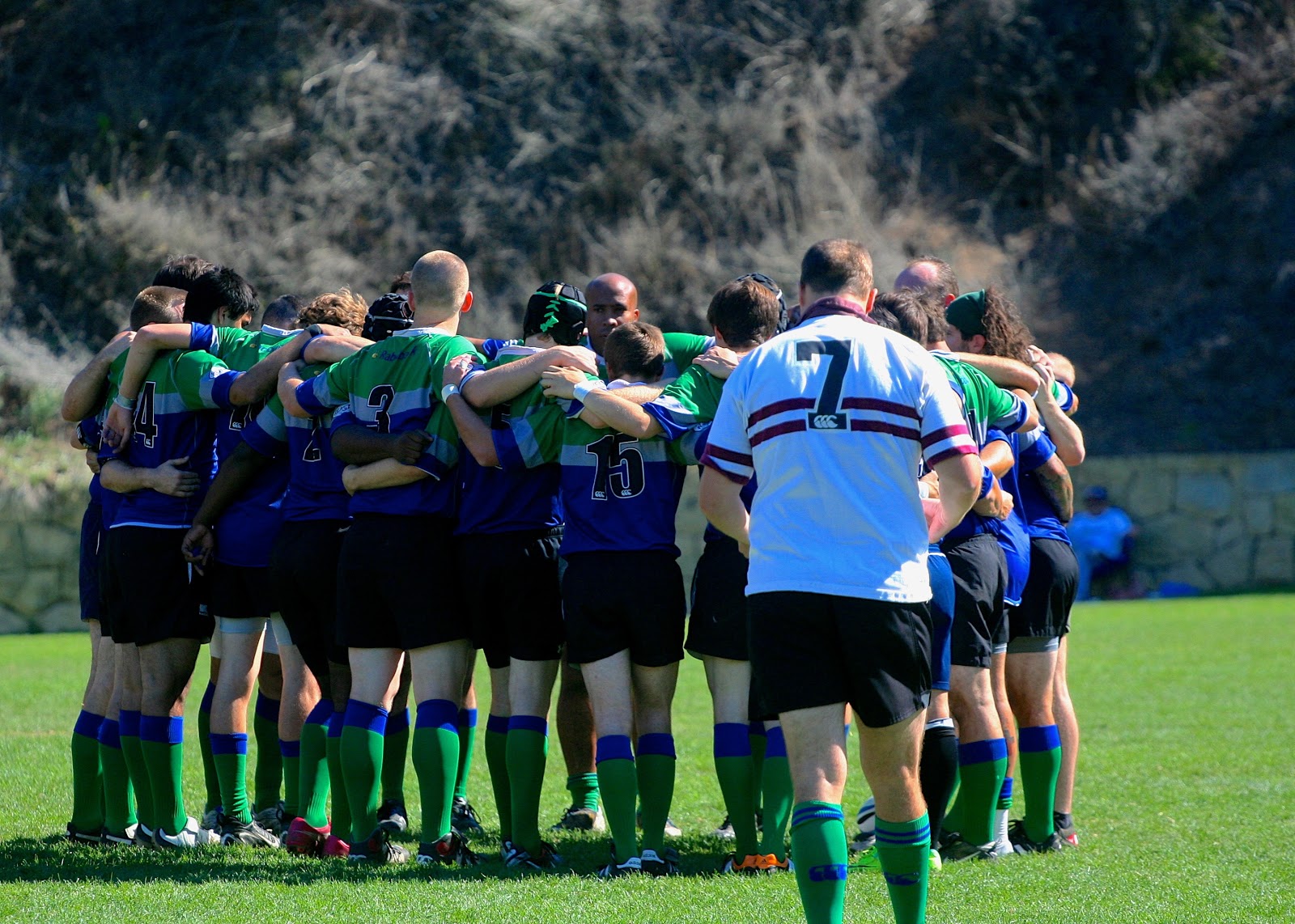 |
| The Santa Barbara Grunions |
Whatever the reason, SB Rugby Day was my first time out on the pitch for a full-contact match. This was an achievement that followed a relatively short run of preparatory touch games and technique-oriented practices.
SB Rugby Day is, you might say, a quantity-over-quantity affair. Games are short, but there are many teams, many games and many chances for vets and rookies alike to get some pre-season playing time.
Several colleges attended and played a mini sevens tournament. There were a few women's sevens sides too, and a handful of masters teams. For our part, the Grunions were picking on guys our own size - full-grown (very full-grown) adults from Ventura and the Inland Empire.
Our first opponent was IE (as a web-developer, I came into the game pre-equipped with a motivational hatred based on that abbreviation alone). They were a smaller side numerically, but a larger side individually. In particular, their forward pack was significantly larger than ours at pretty much every position. Even so, our side was more fit up and down the pitch and had more subs, even after we leant them a few players so that they could contest the match.
The first half was scoreless, but IE had the advantage in territory as well as time of possession. We were holding our own at the scrum, but giving up yardage to pick-and-go runs by their forwards. Line-outs are a strength for the Grunions though and our ability to win line-outs on our opponent's throw probably kept us in the game.
The second half was much more open. IE scored a try first, barreling in after a few phases of play. I entered the game as a substitute in the second half and had a front-row seat for the try that we immediately scored in response. After going left, we passed the ball out to the backs headed right and had significant numbers on the right hand side. The ball made it out to our inside center who streaked by the sole defender in our area to score between the posts.
Following some back-and-forth kicking, the Grunions ended up with a line-out 5 meters outside of the IE goal. We took the line-out and scored the try off of a rolling maul from there. The game had required a lot of effort from our forward pack, so this was a particularly satisfying way for them to win - especially against the heavyweight opposition.
After the IE game, the Grunions had quite a bit of time off, but I decided to spend some of it playing with IE against Ventura. As in our game, the IE team needed players and I knew I wouldn't get much playing time as the day went on, so I was eager to get more "real" game experience. I started at right wing and saw a bit more of the ball than I had in the Grunions game. I successfully contested a grub kick, recovered a loose ball and assisted a bit in containing the opposition a few times. A VERY modest contribution to be sure, but one must start somewhere.
The final Grunion game of the day came against rival Ventura. Instead of two 20-minute halves like the IE game, we played only one 20-minute period (for reference, a normal rugby match is two 40-minute halves. I did not start or play, but I did take some pictures!
Following the match, there were sausages to eat and beers to drink and a field to tear down. Some folks went downtown for Halloween, but I had a flight the following morning and opted to return home for a shower and an early bedtime.
A humble but entertaining start to my late-in-life rugby "career." If you're interested, photos are here.
Monday, October 22, 2012
Solvang days and baking
It had been a while since Chris had come over to make baked goods in our awesome (if sometimes crowded) kitchen. This time around, the recipe was good old fashioned cookies. I made room for a cookie or two, even though I was supposedly on a low-carb diet.

Speaking of low-carb diet breaking, Solvang Days was upon us, which meant a parade through Solvang. What better way to represent the Danish cuisine for which the town is famous than a giant Abelskiver float?
 |
| High in carbs, high in awesomeness |
 |
| These Vikings are a long way from home! |
The actual reason that we went out was that Chris's brother was playing in the beer wagon band. We got to see him play a few songs before the wagon stopped at the beer garden.
 |
| Chris's bro is on drums in the back |
 |
| Chris having some fun with his special lady friend |
Sunday, October 21, 2012
Alpaca Farm
Melch and her co-workers had somehow gotten it into their heads that it would be a good idea to visit an Alpaca farm. It turns out that there's a pretty sizable one adjacent to the Firestone winery in Los Olivos, just a quick jaunt over the pass from Santa Barbara.
Up until our trip, all that I knew of llamas was what I'd learned from the film "The Emperor's New Groove." All that I knew of alpacas was that they were kind of like llamas.
 |
| Kind of like a llama |
 |
| Newly-born Alpaca |
Since alpacas are raised for their wool and my wife and her co-workers are knitters, we talked a lot about the fiber and the yarn/knitted goods that the farm had produced from it. Melch decided that she wanted to knit herself an alpaca-wool sweater and purchased a bunch of gray yarn for the purpose after the tour was over.
Once the transaction was complete, we had to go back out into the fields so that we could meet Thesius, the alpaca from whence Melch's wool had come. Melch promised to come back later and show him "his" sweater once it was completed.

After saying our goodbyes to alpaca, farm-worker and co-worker alike, we went for some wine tasting and a picnic dinner before hopping into the convertible for the sunset drive over the pass. Not a bad Saturday!
Subscribe to:
Posts (Atom)